
Why Healthcare Executives Are the Worst at Writing Their Own CVs
May 09, 2026. By Samona Sarin
A $4M turnaround. Kaiser Permanente on the client list. Number one hospital ranking. Twenty years of exceptional leadership. And a CV that said absolutely none of it.
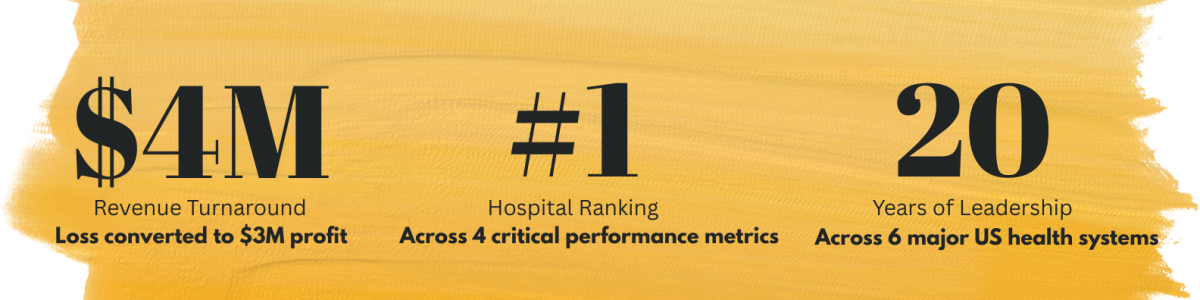
She turned a $4M loss into a $3M profit.
She secured Kaiser Permanente as a client through sheer executive persistence.
She achieved the number one hospital ranking across four critical performance metrics at St. Mary Medical Center.
She holds a Doctorate in Healthcare Administration, an MBA, six clinical certifications, and twenty years of progressive leadership across Cedars-Sinai, Stanford Health Care, Kaiser Permanente, and UCI Health.
Her CV read like a job description.
This is not an unusual story. It is the most common story in senior healthcare recruitment. The more exceptional the career, the worse the CV tends to be. Not because the professional lacks intelligence or achievement. But because the skills that make someone a great healthcare executive are exactly the skills that make self-promotion feel uncomfortable and self-documentation feel like an afterthought.
The result is a document that lists what someone did instead of proving what they delivered. And in a hiring market where CNO, VP Patient Care Services, and Hospital Administrator roles attract hundreds of equally credentialled applications, a CV that lists is a CV that loses.
Why the Best Healthcare Leaders Have the Worst CVs
There is a reason for this and it is not incompetence.
Healthcare executives spend twenty years solving problems for other people. Stabilising units in crisis. Rebuilding retention rates. Redesigning care pathways. Turning around revenue. The work is outward-facing by nature.
Writing a CV asks them to do the opposite. To turn inward. To quantify their own impact. To sell themselves with the same precision they bring to a clinical audit. Most cannot do it. Not because the achievements are not there. But because nobody ever taught them how to translate twenty years of operational excellence into fifteen seconds of executive impact on a page.
So they list. They describe. They document. And the hiring committee moves on.
The more exceptional the career, the worse the CV tends to be. A CV that lists is a CV that loses.
What the CV Was Missing
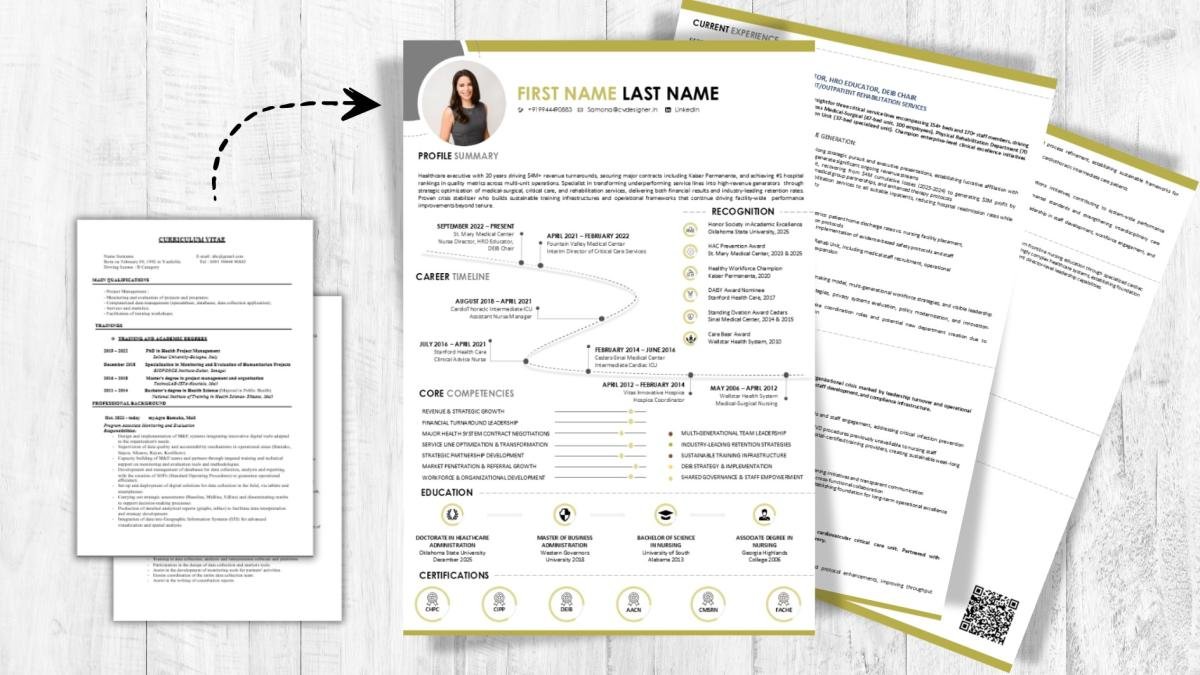
When this profile arrived at CVDesigner, the achievements were all present. They were just buried.
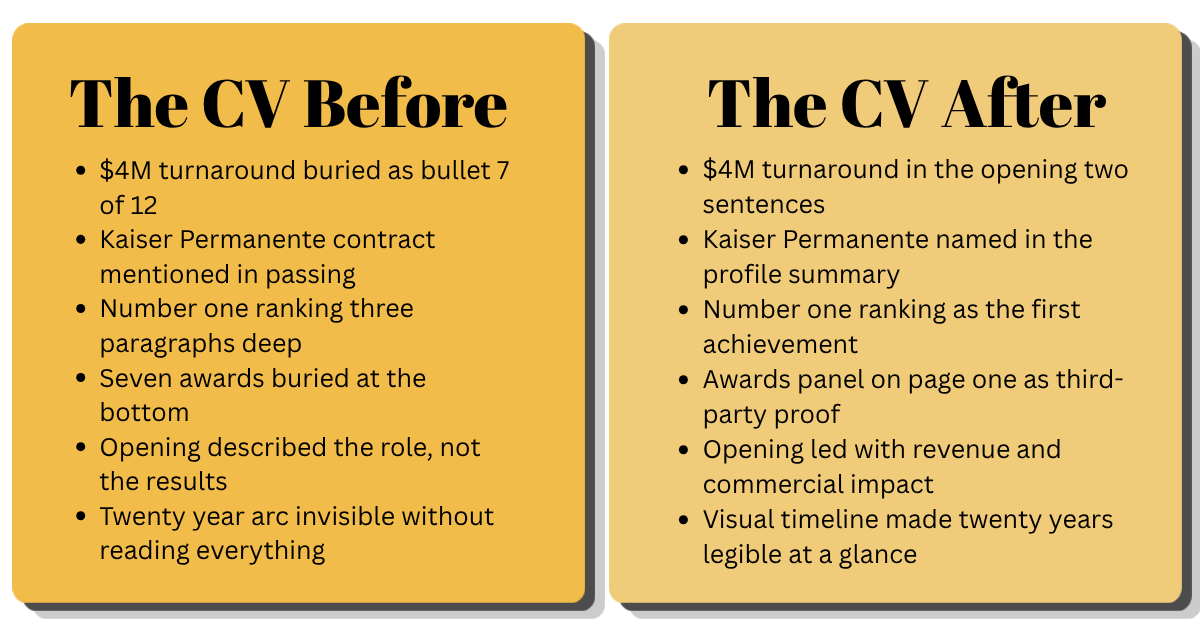
The $4M turnaround was a bullet point among twelve others. The Kaiser Permanente contract was mentioned in passing. The number one hospital ranking sat three paragraphs deep. Seven awards from five organisations were at the bottom of the document where nobody reads. A Chief Executive scanning this CV for thirty seconds would have learned that this person was a Nurse Director. Nothing more. That is a $4M story told in three words.
The Before & After
What We Changed and Why Every Decision Mattered
The opening became a revenue statement, not a role description
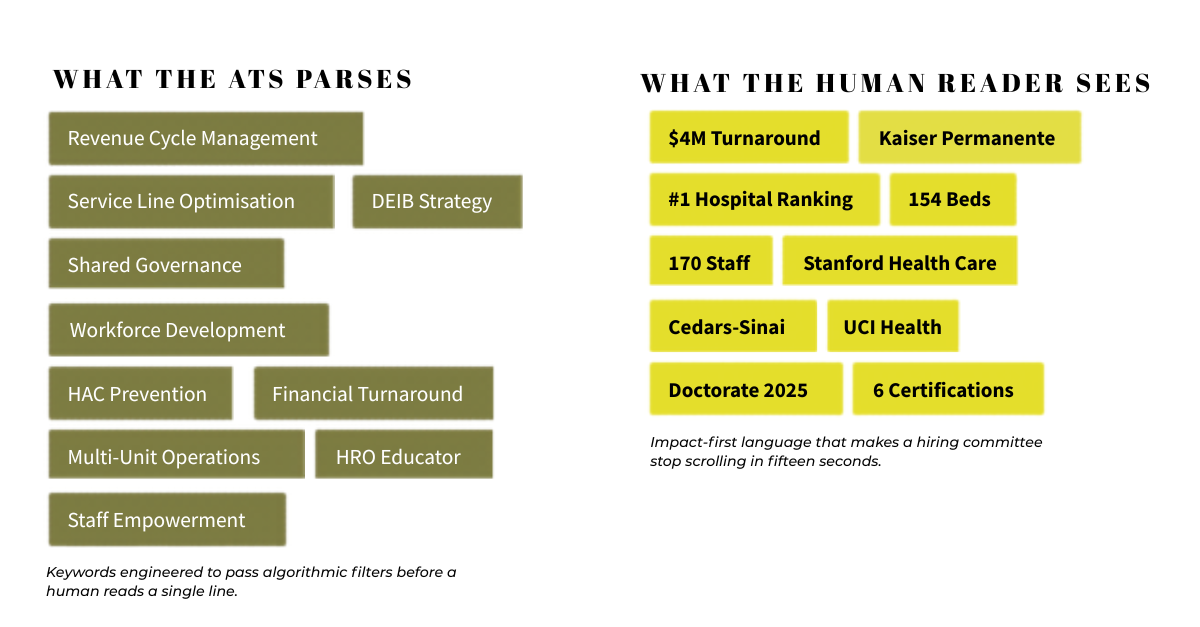
The first two sentences of any executive CV determine whether the next two pages get read. We opened with the number. Twenty years driving $4M revenue turnarounds. Securing major contracts including Kaiser Permanente. Achieving number one hospital rankings in quality metrics across multi-unit operations. A health system CEO reading this knows within fifteen seconds what kind of executive they are looking at.
The career timeline became a visual asset
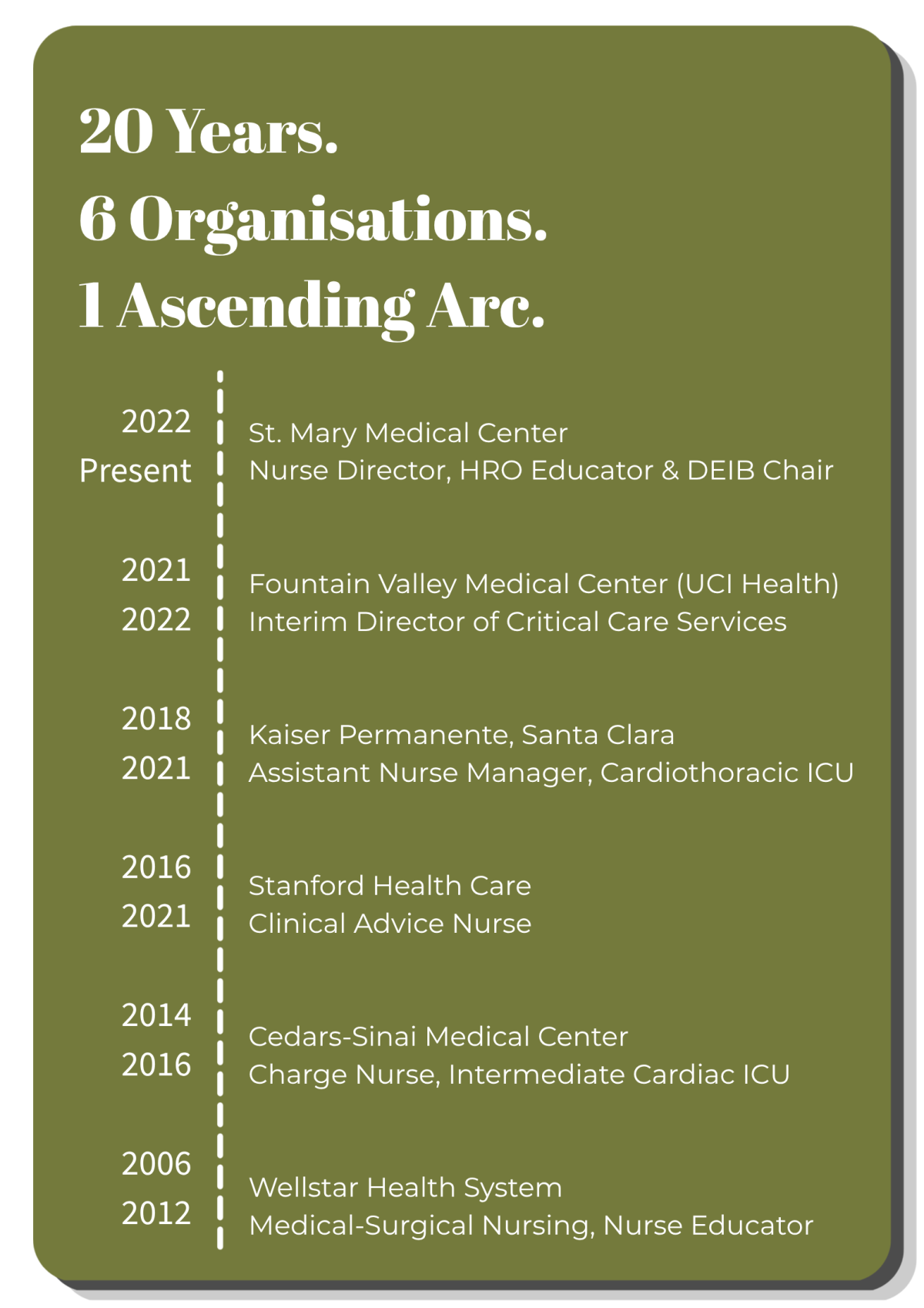
Twenty years across six organisations is a story of deliberate, ascending progression. That story needs to be seen, not read. We built a visual career timeline that made the entire arc legible in a single glance.
Career Progression Arc
The competencies were built for ATS and human readers simultaneously
Every term in the competencies section is a genuine capability. Every term is also a keyword that ATS systems at major health networks parse before a human ever sees the document. Both audiences served. Neither compromised.
Dual Audience Optimisation
The Awards moved to page one
Seven awards from five organisations including Kaiser Permanente, Stanford, and Cedars-Sinai are not footnotes. They are third-party validation of every claim in the experience section. We moved them to a dedicated panel on page one where they function as evidence, not decoration.
The Before and After in One Sentence
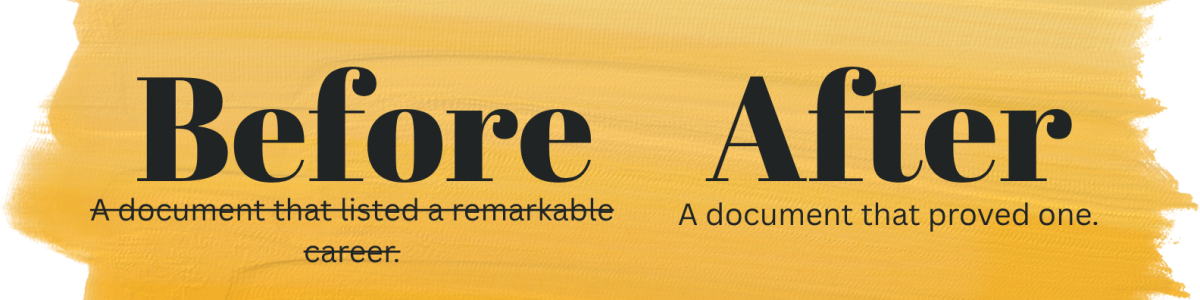
A CV that a health system CEO or executive search consultant can pick up and understand in thirty seconds. That leads with the revenue story. That surfaces awards as evidence. That traces the clinical progression clearly. That passes ATS filters without sacrificing the human narrative.
A CV that does not ask a hiring committee to imagine what kind of executive this candidate is. It shows them.
What This Means for You
If you are a healthcare executive, a nursing director, a hospital administrator, or a clinical leader whose career has delivered results that your CV is not communicating, the problem is structural, not personal.
Your career is the asset. The CV is the instrument that communicates it. And like any clinical instrument, it needs to be calibrated correctly to deliver accurate results.
A CV that lists your responsibilities will always lose to a CV that proves your impact. A CV that buries your revenue story will always lose to one that leads with it. These are fixable problems.
What This CV Unlocked
| CV Type | Customized Visual CV Plus Add Ons |
| Designation | Nurse Director, HRO Educator and DEIB Chair with 20 years of multi-unit healthcare leadership across Medical-Surgical, Critical Care, and Rehabilitation services |
| Industry | Healthcare, Hospital Administration, Nursing Leadership, Clinical Operations |
| Target Positions | Chief Nursing Officer, VP Patient Care Services, Hospital Administrator, Director of Clinical Operations, COO Healthcare |
| Target Markets | US health systems, Gulf healthcare networks, Indian hospital groups, International hospital management companies |
| Investment | INR 16,999 plus taxes |
| Turnaround Time | 3 working Days |
RECENT BLOGS
-

How to Write a Senior Customer Success CV That Actually Gets You Noticed
-

Why the Best Procurement Leaders Are the Hardest to Hire
-

The Single-Employer Trap: Why 20 Years at One Company Can Look Like Standing Still - and How CVDesigner Fixed It
-

The Patent Paradox: Why the Most Credentialed Aerospace Executives Have the Weakest Resumes
ADD COMMENTS
Your email address will not be published. Required fields are marked *