
The Patent Paradox: Why the Most Credentialed Aerospace Executives Have the Weakest Resumes
May 12, 2026. By Samona Sarin
Read this first - it will save you months of confusion
Four US patents. Twenty-one years across GE Aviation, GE Power, and Alstom. A $25 billion aerospace execution portfolio. Thirty airline operators across fourteen countries. A 20-year service agreement covering 800 engines for Asia's largest low-cost airline.
Now here is the question that should make every aerospace professional reading this genuinely uncomfortable:
If a recruiter looked at your resume for six seconds right now - which is all the time they will give it on a first pass - would they know any of that?
Not feel it. Not infer it. Know it. Immediately, visually, undeniably.
For most senior technical leaders, the honest answer is no. And the reason is not a lack of achievement. It is something far more specific - and far more fixable.
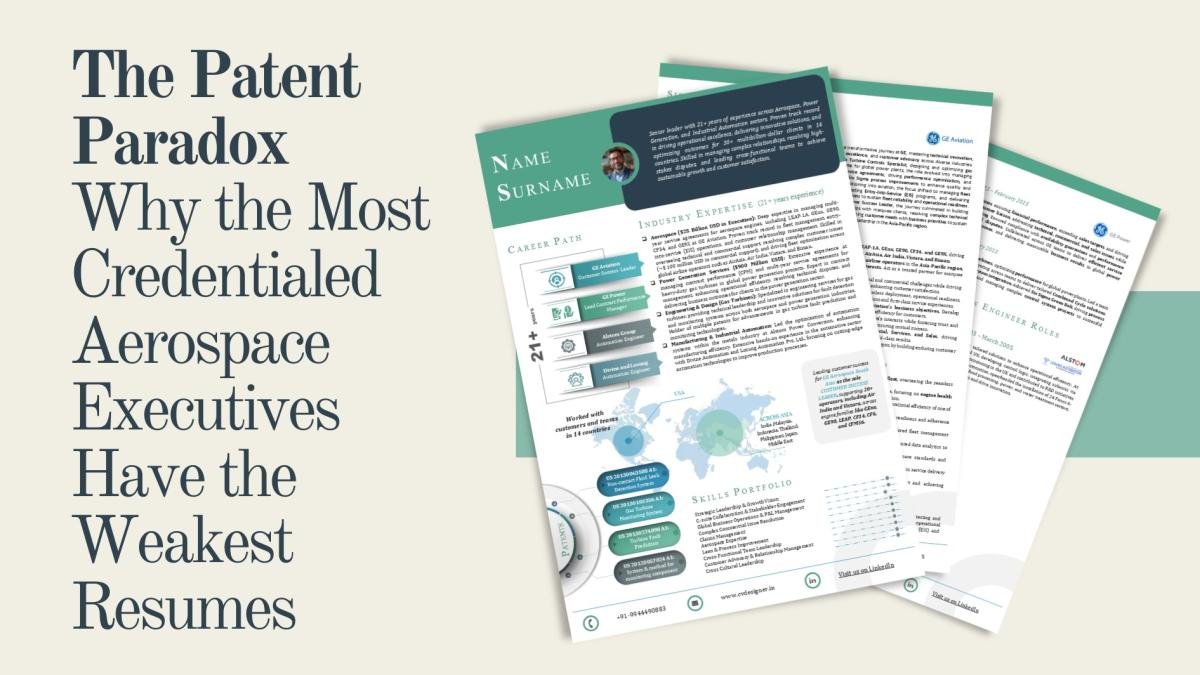
This is the story of how CVDesigner rebuilt a GE Aviation Customer Success Leader's resume from the ground up. Not by inventing credentials. By making the ones that already existed impossible to miss.
The Paradox Nobody in Aerospace Talks About
Here is something counterintuitive about the relationship between technical expertise and self-presentation: the deeper your expertise, the worse you tend to be at communicating it to people who are not already inside your world.
Think about it. A patent attorney reading "US 20130274898 A1: Turbine Fault Prediction" knows exactly what that means - the intellectual rigour involved, the commercial implications, the years of research and iteration that precede a granted patent. But a Vice President of Human Resources at an airline shortlisting candidates for a commercial leadership role? They see a patent number and move on, because nothing on the page tells them why it matters or what it proves about the person holding it.
This is the patent paradox: the credential that should differentiate you most powerfully is the one most likely to be invisible on a standard resume.
And patents are just the most dramatic example of a broader problem. The same invisibility applies to financial scale ($25 billion in execution sounds enormous - but not if it is buried inside a bullet point that begins with "Responsible for managing service agreements"). It applies to geographic scope (fourteen countries is a significant signal of seniority - but only if it is foregrounded, not tucked into location tags beside job titles). It applies to the complexity of the work itself (managing a 20-year Comprehensive Service Agreement covering 800 engines for AirAsia is not the same thing as "managed CSA performance" - but a standard resume treats them identically).
The paradox, in short, is this: the more extraordinary your career, the more disciplined you need to be about making it legible. And discipline in self-presentation is not something aerospace and engineering professionals are trained for. They are trained to solve for precision and depth, which are exactly the wrong instincts when you have six seconds to make an impression.
What Was Actually on the Page - and What Was Missing
Let us be specific about the before state. Not a hypothetical. A pattern CVDesigner has seen hundreds of times in senior technical leaders' resumes, and one that maps precisely to what a Customer Success Leader at GE Aviation with this profile almost certainly submitted before engaging us.
The summary problem: breadth without altitude
A typical self-written summary for a professional at this level covers every domain - aerospace, power generation, automation, customer success, technical leadership, commercial management - in a single paragraph that becomes so comprehensive it stops communicating anything precisely.
The instinct is understandable. Twenty-one years across multiple industries feels like it should be acknowledged in its entirety. But a recruiter reading a summary that covers six domains in eight sentences does not think: "impressive range." They think: "what does this person actually do?"
Breadth without altitude - listing everything without establishing the seniority level at which all of it was done - is one of the most common mistakes senior technical leaders make. And it is particularly damaging for professionals whose seniority is genuinely high, because it obscures the very thing that should be the headline.
The credential burial problem: patents in a footnote
Four US patents for innovations in gas turbine fault prediction and monitoring systems. In most industries, one patent would be a career highlight. In aerospace engineering, holding four - with registered US numbers - signals a level of intellectual contribution that very few professionals at any career stage achieve.
On a standard self-written resume, these patents are listed at the bottom of the document in a certifications or achievements section. Same font size as "OSHA certified." Same visual weight as "Six Sigma Green Belt." Nothing about the formatting signals that these represent original contributions to the field of gas turbine technology.
A recruiter's eye does not reach the bottom of a resume on a first pass. If your most distinctive credential is there, it might as well not exist.
The scale problem: numbers without context
"$25 billion in execution" is a staggering number. It communicates portfolio scale, risk management at the highest level, and commercial accountability that most professionals - even senior ones - will never experience.
But a number without context is just a number. "Responsible for managing service agreements valued at $25 billion" tells a recruiter the size of the portfolio. It does not tell them that this professional was the single point of accountability for thirty airline operators across Asia-Pacific, personally navigating technical disputes that could have triggered nine-figure liability events, and simultaneously managing entry-into-service programs for multiple airlines with zero tolerance for operational failure.
Context is what converts a number into evidence of seniority. Without it, even $25 billion is underwhelming.
The geographic invisibility problem: fourteen countries in parentheses
Fourteen countries is not incidental. Operating across India, Malaysia, Indonesia, Thailand, the Philippines, Japan, the Middle East, and the US - managing clients, navigating regulatory environments, leading cross-cultural teams, and maintaining relationships with airline operators across Asia-Pacific - is a defining characteristic of this professional's seniority level.
On a standard resume, it appears as a location tag. "New Delhi, Delhi, India." "Kuala Lumpur, Malaysia." The countries are technically present. But they are formatted as administrative metadata, not as evidence of global leadership scope.
The Transformation - What CVDesigner Changed and Why
Decision 1: Lead with altitude, not breadth
The first thing CVDesigner rewrote was the opening profile. The directive was simple: establish the level before establishing the range.
The after resume opens by naming the years of experience and the industries - but immediately anchors them to a specific scale: thirty multibillion-dollar clients, fourteen countries. Before the reader has processed the domain expertise, they have processed the seniority. The profile then names the capabilities that define this leader not as a technician - but as an executive. Operational excellence. Innovative solutions. High-stakes dispute resolution. Cross-functional leadership. Sustainable growth delivery.
The technical credentials are present. But they are subordinate to the leadership identity. Because at this stage of a career, that hierarchy is the truth of who this person is.
Why it works psychologically: Readers form a first impression within 50 milliseconds of seeing a page and within the first sentence of reading text. If the first sentence establishes seniority and scale, every subsequent line is read through that lens. If the first sentence lists domains without establishing altitude, the reader begins forming a specialist impression that is very difficult to reverse - even if the rest of the document contradicts it.
Decision 2: Give each career chapter its own financial identity
The standard resume structure forces every career chapter into the same format: company, role, dates, bullets. It treats a $900 million power generation contract management role with the same visual weight as a junior engineering position. A recruiter has no structural signal to tell them which chapter of this career was the most significant, or what scale each chapter operated at.
CVDesigner introduced an Industry Expertise section - a structural innovation that does not exist in standard resume formats - that breaks the career into four distinct domains, each with its own financial scope and proof of depth before the detailed role descriptions begin.
Aerospace at $25 billion in execution. Power Generation at $900 million. Engineering and Design with four registered patents. Manufacturing and Industrial Automation with hands-on systems leadership across automotive and industrial sectors.
Each domain gets its own paragraph. Each paragraph names the specific technologies, clients, and outcomes that define expertise in that space. By the time a recruiter reaches the detailed role descriptions, they already understand the architecture of this career. The role descriptions become confirmation rather than discovery - which is exactly how a strong resume should work.
Why it works psychologically: Cognitive load theory tells us that readers comprehend complex information better when it is organised into chunks with clear labels than when it is presented as a linear sequence. A career spanning four distinct domains across twenty-one years is genuinely complex. Giving each domain its own labelled section reduces the cognitive effort required to understand the full scope - and a recruiter who finds a document easy to process is a recruiter who feels positively about the candidate.
Decision 3: Move the patents to page one - and frame them as what they are
The four patents were relocated from wherever they sat in the original document to a visually prominent section on page one of the after resume, each listed with its US registration number and invention name:
- US 20130063588 A1: Non-contact Fluid Leak Detection System
- US 20130103356 A1: Gas Turbine Monitoring System
- US 20130274898 A1: Turbine Fault Prediction
- US 20120057024 A1: System and Method for Monitoring Component Wear
But location is only half the decision. The other half is framing. The after resume does not just list the patents - the Industry Expertise section introduces them as evidence of intellectual leadership in gas turbine engineering, contextualised within the professional's broader technical trajectory. By the time a recruiter sees the patent numbers, they already understand what the patents represent and why they matter.
Why it works psychologically: The primacy effect - the cognitive tendency to remember and weight information that appears early in a sequence - is one of the most robust findings in memory research. Credentials that appear on page one of a resume are remembered. Credentials that appear at the bottom of page three are not. Relocating the patents was not a cosmetic decision. It was a memory architecture decision.
Decision 4: Make fourteen countries impossible to ignore
The after resume includes a visual world map with explicit callout markers for the US and across Asia - India, Malaysia, Indonesia, Thailand, the Philippines, Japan, the Middle East. Adjacent to the map: "Worked with customers and teams in 14 countries."
Separately, on the same page, a standalone statement about the current role: "Leading customer success for GE Aerospace South Asia as the sole Customer Success Leader, supporting 20+ operators, including Air India and Vistara, across engine families like GEnx, GE90, LEAP, CF34, CF6, and CFM56."
The word "sole" is not decorative. It is the most important word in that sentence. This professional is not one of several customer success leaders dividing the South Asia territory. They are the single point of accountability for every operator relationship in the region. That distinction - carrying an entire geography's customer relationships on one set of shoulders - communicates a seniority and trust level that no bullet point can convey as efficiently as one precise word.
Why it works psychologically: Visual information is processed 60,000 times faster than text. A world map with callout markers communicates geographic scope in under a second. A recruiter who has already processed the map before reading the role descriptions brings a mental frame - "this person operates globally" - that colours everything they subsequently read. CVDesigner designs for that frame, not just for the text.
Decision 5: Reframe the career arc as a deliberate ascent, not a chronological log
The after resume opens the GE Aviation section with a narrative overview - three paragraphs that describe the professional's trajectory at GE not as a list of roles but as a story of deliberate growth: from Turbine Controls Specialist designing gas turbine systems for global power plants, to managing multi-year service agreements and implementing Six Sigma process improvements, to leading fleet performance for one of the world's largest LEAP-1A fleets, to rising as the Customer Success Leader responsible for GE Aerospace's strategic relationships across South Asia.
This narrative does something that no bullet list can do: it gives a recruiter a reason to be impressed by the progression, not just informed about it. The arc from engineer to commercial executive - spanning power generation, aviation engineering, fleet management, and customer success leadership - is a story of deliberate, compounding growth. Written as a narrative, it reads that way. Written as a list of job titles, it reads as coincidence.
Why it works psychologically: Humans are wired for narrative. We process stories faster, remember them longer, and are more persuaded by them than by equivalent information presented as data. A career that is genuinely impressive - when written as a sequence of bullet points - can feel underwhelming because bullet points strip the causal connections between events. Restoring those connections through narrative is not embellishment. It is accurate representation.
Part Four: What the After Resume Communicates That the Before Resume Never Could
Here is the honest summary of what changed - not in the professional's career, but in what a recruiter walks away knowing after six seconds with the document:
Before: Senior GE professional, aerospace background, long career, technically strong.
After: Customer Success Leader with sole accountability for GE Aerospace's South Asia region, managing $25 billion in execution across thirty airline operators in fourteen countries, holder of four US patents for gas turbine innovation, with a career arc spanning turbine controls engineering through fleet management to executive-level commercial leadership - all before the recruiter has read a single bullet point.
The career did not change. The document did. And the document is what gets you the call.
Is This What Your Resume Is Doing?
How do I know if my resume is communicating my seniority level accurately?
Here is a fast diagnostic. Read your opening profile and ask: does this paragraph establish what level I operate at before it establishes what domains I cover? If the answer is no - if your summary reads like a list of functions rather than a statement of altitude - it is the first thing to fix.
Then ask: where are my most distinctive credentials? If patents, awards, or significant financial scale appear below the fold - below the first visible section without scrolling - they are being processed too late to shape first impressions.
Finally, ask: does my resume require a recruiter to read it carefully to understand my seniority? If careful reading is required, the document has failed. At the executive level, seniority should be self-evident at a glance.
Common Mistakes Senior Technical Leaders Make on Their Resumes
- Writing a summary that covers every domain without establishing the seniority level at which all of them were operated
- Listing patents, publications, or intellectual contributions in supplementary sections instead of foregrounding them as primary credentials
- Presenting financial scale - portfolio sizes, execution values, contract scopes - as context rather than as headline evidence of seniority
- Allowing geographic scope to be invisible because it is embedded in location metadata rather than stated explicitly
- Writing role descriptions that describe what the job required rather than what this particular person delivered inside the role
- Presenting a multi-domain career as a flat chronology rather than as an architecture of compounding expertise
- Ordering skills by technical depth rather than by seniority signal - leading with tools instead of leading with leadership
Best Practices for Aerospace and Engineering Executive Resumes
- Establish altitude before breadth: the opening profile should communicate seniority level in the first sentence
- Create structural separation between different career domains - an industry expertise section allows each chapter to carry its own financial identity
- Surface patents and intellectual contributions on page one, framed as evidence of domain leadership rather than listed as certifications
- Make geographic scope explicit and visual - it is a seniority signal, not administrative metadata
- Write career transitions as deliberate narrative arcs, not as coincidental sequences of roles
- Build role descriptions around what you personally delivered, not what the role required
- Lead the skills section with strategic and commercial capabilities - not technical tools - to signal executive identity, not specialist identity
Frequently Asked Questions
Q1. Why is my aerospace resume not getting shortlisted despite 20+ years of experience?
Experience alone does not shortlist resumes - the document does. The most common reasons senior aerospace professionals do not get calls despite deep experience are: a summary that lists domains without establishing seniority level, significant financial scale buried in body text, distinctive credentials like patents positioned too late in the document to be seen on a first pass, and role descriptions that describe responsibilities rather than personal contributions to outcomes. Any one of these can suppress response rates. CVDesigner's process identifies which specific elements are creating friction and fixes them.
Q2. How should patents be included on an executive resume?
Patents should be positioned as primary credentials on page one - not listed in a supplementary certifications section at the bottom. Each patent should be named with its registration number and invention title. Where possible, the surrounding context should explain what the patent represents in terms of contribution to the field, so that both specialist and generalist recruiters understand its significance. A patent listed without context is a missed opportunity. A patent framed as evidence of intellectual leadership in your domain is a powerful differentiator.
Q3. How do you write a resume when your career spans aerospace, power generation, and industrial automation?
The key is architectural separation. Rather than forcing a multi-domain career into a flat chronological format - which obscures the depth of each chapter - CVDesigner creates an industry expertise section that gives each domain its own financial scope, specific technologies, and proof of expertise before the detailed role descriptions begin. This allows a recruiter to understand the architecture of the career before reading any individual role, which dramatically improves comprehension and reduces the cognitive effort required to evaluate the document.
Q4. Should a senior aerospace executive's resume be more than two pages?
For a career spanning 21+ years across multiple industries, geographies, and seniority levels, three pages is not just acceptable - it is the appropriate scope. The relevant question is not how many pages the document runs to, but whether every page is earning its place. A well-structured three-page executive resume with visual hierarchy, domain-separated content, and achievement-led role descriptions is significantly more readable than a compressed two-page document that sacrifices clarity for brevity.
Q5. What does CVDesigner do differently for technical and engineering executives?
Most resume writing services apply a generic executive template and substitute in the client's specific job titles and bullet points. CVDesigner approaches each engagement as a career positioning exercise - understanding the specific language, credentials, and seniority signals that distinguish senior professionals in aerospace, power generation, and engineering before a word is written. The result is a document that feels native to your industry, not like a business-school resume with technical terms inserted.
RECENT BLOGS
-

How to Write a Senior Customer Success CV That Actually Gets You Noticed
-

Why the Best Procurement Leaders Are the Hardest to Hire
-

The Single-Employer Trap: Why 20 Years at One Company Can Look Like Standing Still - and How CVDesigner Fixed It
-

The Patent Paradox: Why the Most Credentialed Aerospace Executives Have the Weakest Resumes
ADD COMMENTS
Your email address will not be published. Required fields are marked *