
The Architecture of a Career: How We Redesigned a Commissioning Engineer's CV to Command Attention
May 04, 2026. By Samona Sarin
Twenty-one years of high-stakes engineering experience across five countries - condensed, elevated, and redesigned to open doors in the most competitive hiring markets on earth
There is a particular kind of professional that the job market routinely undervalues - not for lack of skill, but for lack of presentation. A Senior Commissioning Engineer with over two decades of international project experience, a trail of large-scale power plants and desalination facilities behind them, and a technical command that few in their field can match. Yet their CV? A dense, monochromatic document that read more like a site report than a career narrative.
That was the precise challenge that landed on our desk at CVDesigner. The brief was clear: transform a technically exhaustive but visually underwhelming CV into a professional CV design that could stand confidently before hiring managers in the Gulf, South Asia, and Southeast Asian energy markets - without sacrificing a single line of substantive expertise.
This is the story of how we did it. And more importantly, why the approach worked.
"A CV is not a document. It is the first impression of an entire career. It deserves the same precision its owner brings to every commissioning project."
The Problem with Most Engineering CVs
In technical professions - and commissioning engineering in particular - there is a cultural tendency to let credentials do the talking. The assumption runs something like this: my projects speak for themselves. And in many ways, they do. But only if the reader can find them.
Hiring managers in the energy and infrastructure sector receive dozens, often hundreds, of applications for senior roles. Research consistently shows that the initial scan of a CV takes fewer than ten seconds. In that window, a disorganised, text-heavy professional CV - no matter how impressive its content - will not survive. ATS systems, which now filter most applications before a human eye ever sees them, introduce a second layer of complexity entirely.
Our client's original CV suffered from precisely these vulnerabilities. The experience was real, formidable even - projects spanning a 4,620 MW power facility in Gujarat, a co-generation plant adjacent to the Arabian Sea in Saudi Arabia, and an offshore desalination operation on a UAE island hub. But none of it landed with the visual clarity or structural logic that modern recruiters and applicant tracking systems demand.
The CVDesigner Approach: Structure Before Style
Our first principle at CVDesigner has always been that good CV design is, above all, good information architecture. Before a single colour is chosen or a layout committed to, we audit the raw material - asking what the client's career actually communicates, what their target roles require, and where the two most powerfully intersect.
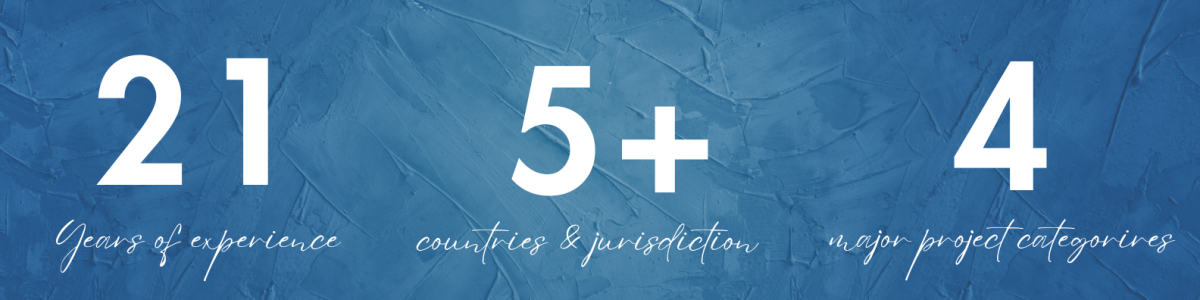
For this client, that audit revealed several things of immediate strategic importance. First, his career timeline was genuinely remarkable - a continuous, ascending journey from an Instrumentation Engineer role in 2004 through to a current position managing multi-hundred-million-dollar energy projects in the UAE. That progression deserved to be shown, not merely listed.
Second, the breadth of his technical expertise - encompassing PLC programming, P&ID review, loop calibration, DM plant commissioning, RO desalination, FAT & SAT, and quality assurance - was scattered across the document with no visual hierarchy. A recruiter at a firm like a major EPC contractor or an oil and gas operator needed to absorb that expertise profile within moments, not excavate it across three pages.
Third, and critically, his leadership record was buried. At Earth Water Group, he had led a team of 88. At ION Exchange, 24. These are not footnotes. They are defining data points for any senior engineering or project management role.
CVDESIGNER DESIGN PRINCIPLE
Visual hierarchy is not decoration. It is the mechanism by which a recruiter's eye is guided from what matters most to what matters next - in precisely the order the candidate needs them to see it.
Crafting the Visual CV: What Changed and Why
The redesigned visual CV we produced for this client introduced several deliberate structural and aesthetic decisions, each grounded in what professional CV design research and our own experience with senior engineering CVs tells us works.
The career timeline as a centrepiece visual
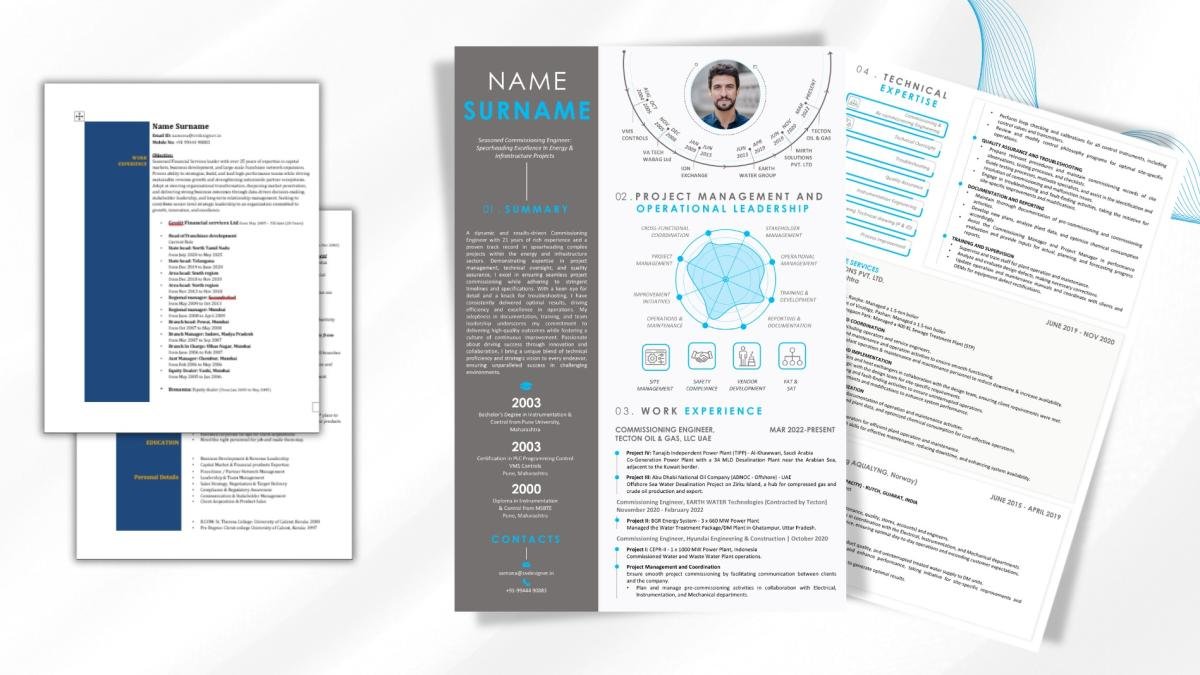
Rather than a standard reverse-chronological list, we introduced a circular career timeline - a radial diagram placing each employer at a chronological position, making the breadth and continuity of his 21-year journey immediately legible. This single design decision transformed the experience section from a document that needed to be read into one that could be understood at a glance. For roles in energy, infrastructure, and oil and gas - where depth of experience is the primary credential - this matters enormously.
The skills radar chart
Technical expertise profiles are notoriously difficult to communicate on a traditional CV. A bulleted list of competencies carries no weight differentiation. Our spider/radar chart for the project management and operational leadership section solved this elegantly - allowing the client's strongest capabilities (project management, cross-functional coordination, stakeholder management) to be visible as a shape, not merely a list. Hiring managers and technical recruiters can process this instantly.
A dual-column architecture
We structured the CV around a strong left column housing credentials, education, and contact information - and a generous right column dedicated to experience and technical depth. This format is both ATS-compatible when properly coded and visually sophisticated for human readers. Critically, it compresses vertical length without sacrificing content.
Typography and colour with intent
Every typographic choice in a professional CV should do functional work. We used a bold, legible display treatment for the name and section headers, a clean sans-serif body for experience detail, and a controlled two-colour palette - a deep teal-blue and a warm off-white - that conveys technical authority without the sterility of a purely monochrome document. Colour in CV design is not vanity. It is a wayfinding system.
The SEO of a CV: Keywords, Context, and ATS Optimisation
Modern job seekers - even those with decades of senior experience - often overlook a fundamental truth: a CV must be optimised for machines before it can impress people. Applicant tracking systems deployed by major engineering firms, staffing agencies, and oil and gas operators parse incoming CVs for keyword relevance before a human recruiter ever sees the document.
For a Senior Commissioning Engineer, this means ensuring that terms like pre-commissioning activities, loop checking and calibration, P&ID documentation, FAT and SAT, DM plant, and RO desalination appear naturally and prominently throughout the document - not stuffed artificially, but woven into achievement-led descriptions that also satisfy a human reader.
Our editorial process ensures that every CV we produce at CVDesigner passes this dual test: keyword density sufficient to rank well within ATS systems, and narrative quality compelling enough to hold a recruiter's attention once the document lands on their desk.
Our five-point ATS optimisation framework
- ATS keyword mapping - Role-specific terminology embedded organically throughout the document
- Quantified achievements - Teams of 88, facilities of 47 MLD capacity, power plants at 4,620 MW - numbers that validate scale
- Action-led language - Every bullet begins with a strong verb: managed, commissioned, supervised, developed, optimised
- Consistent formatting - ATS systems penalise inconsistency; every date, title, and employer follows a fixed pattern
- Clean file architecture - Delivered in formats that parse cleanly through both software systems and PDF readers
What Made This CV Work
The final result was a three-page visual CV that functions on every level a modern CV must. It opens with a commanding name treatment and a precisely worded professional summary - the kind of elevator pitch in print that orients a reader immediately. It moves into a skills and competency overview that rewards a ten-second scan. And it delivers the full depth of experience for those who dig deeper.
Perhaps most importantly, the redesign gave the client something intangible but essential: confidence in how they are perceived on paper. A professional CV that looks as accomplished as its owner's career is not a cosmetic exercise. It is a strategic investment in the first impression that determines whether the phone rings.
For senior professionals in commissioning, instrumentation, project management, and energy infrastructure - engineers who have spent careers on site, not crafting personal brand documents - the gap between their actual capability and their CV presentation is often the only thing standing between them and their next great role.
"The redesign gave the client something intangible but essential: confidence in how they are perceived on paper."
The CVDesigner Philosophy
At CVDesigner, we believe that every professional deserves a CV that is worthy of their experience. Not a template. Not a generic layout downloaded from a job board. A bespoke, carefully considered document that reflects the specificity of a career - its industries, its scale, its progression - and presents that career in the format that the modern hiring landscape demands.
For every CV we create, we bring the same rigour that our clients bring to their own work. The same attention to structure, hierarchy, and detail. The same commitment to getting it right - not just good enough, but right.
Whether you are a commissioning engineer with two decades of international project experience, a fresh graduate entering a competitive market, or a mid-career professional pivoting into a new sector, your CV is the most important professional document you own. It deserves to be designed accordingly.
That is the science - and the craft - behind what we do.
RECENT BLOGS
-

How to Write a Senior Customer Success CV That Actually Gets You Noticed
-

Why the Best Procurement Leaders Are the Hardest to Hire
-

The Single-Employer Trap: Why 20 Years at One Company Can Look Like Standing Still - and How CVDesigner Fixed It
-

The Patent Paradox: Why the Most Credentialed Aerospace Executives Have the Weakest Resumes
ADD COMMENTS
Your email address will not be published. Required fields are marked *