
From Invisible to Indispensable. The Resume Shift That Changes Everything
Apr 20, 2026. By Samona Sarin
Most resumes don’t fail loudly.
They fail quietly.
They look “fine.” They list experience. They mention responsibilities. They even throw in a few achievements here and there. On the surface, nothing seems wrong.
And yet, they get ignored.
No callbacks. No serious conversations. No traction.
Because in today’s hiring market, “fine” is invisible.
This is where the idea of a resume transformation gets misunderstood. People assume it’s about design. Maybe better formatting. Slightly improved wording.
That’s not transformation.
That’s decoration.
A real transformation rewires how your career is perceived.
Let’s break this down using a senior healthcare technology leader’s profile. Someone with 20+ years of experience, leadership exposure, and significant enterprise impact.
On paper, this person should be in demand.
In reality, before the transformation, they were just another profile in the pile.
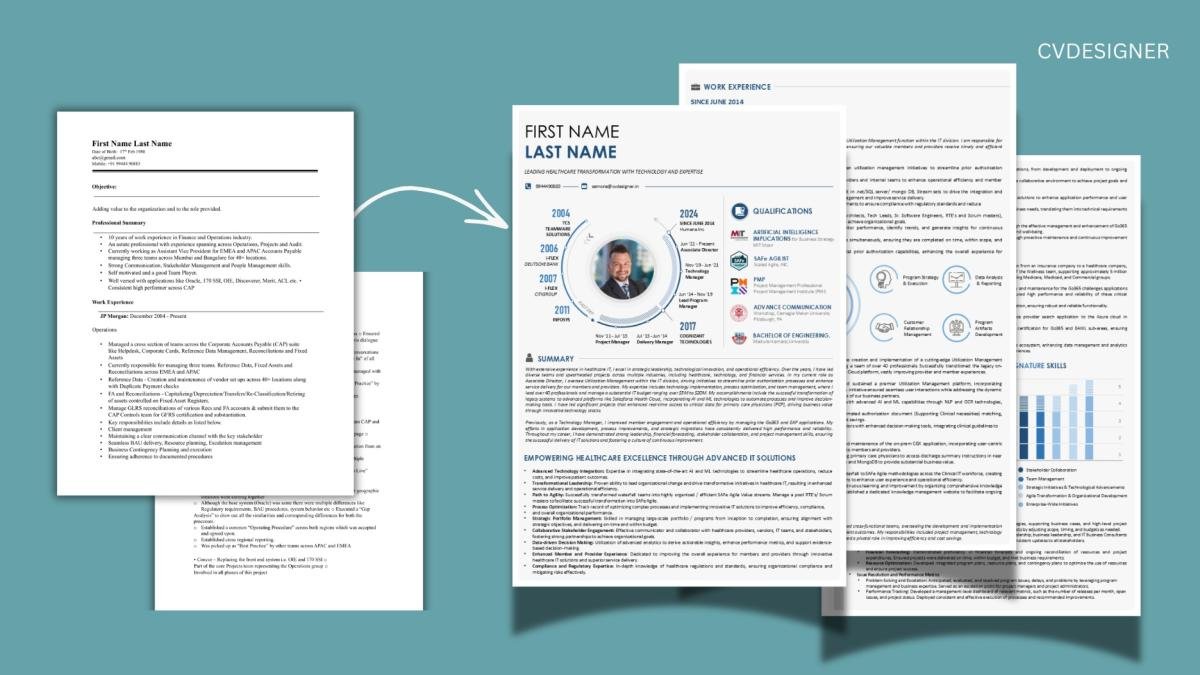
The “Before” Resume. Where It Quietly Fails
The original version had everything most professionals rely on:
- Long paragraphs describing roles
- Generic leadership claims
- Responsibilities listed without context
- Achievements buried inside text
- No clear narrative or positioning
It wasn’t bad.
That’s the problem.
It didn’t give a recruiter a reason to stop.
At senior levels, recruiters aren’t reading resumes line by line. They are scanning for signals:
- Scale of impact
- Strategic ownership
- Business outcomes
- Leadership depth
- Transformation experience
The “before” resume didn’t surface any of this clearly.
For example, leading large teams was mentioned, but without scale clarity.
Technology initiatives were listed, but without business relevance.
Transformation work existed, but it sounded like routine execution.
The result?
A profile that looked operational instead of strategic.
And that’s a career-limiting mistake.
The Shift. From Information to Positioning
The transformation didn’t start with writing.
It started with reframing.
Instead of asking, “What has this person done?” the question became:
“What should this person be known for?”
That single shift changes everything.
The final positioning was built around three pillars:
- Healthcare IT Transformation Leadership
- AI and Data-Driven Innovation
- Large-Scale Program and Portfolio Execution
Now suddenly, this isn’t a “Technology Manager.”
This is a transformation leader operating at enterprise scale.
Same career.
Completely different perception.
The “After” Resume. What Actually Changed
Let’s get into the real upgrades.
Not the cosmetic ones. The ones that actually move the needle.
1. A Summary That Signals Authority
The new summary doesn’t describe.
It positions.
Instead of generic statements, it establishes:
- Industry specialization (Healthcare IT)
- Strategic capabilities (innovation, transformation, efficiency)
- Leadership scope (40+ professionals, multimillion-dollar budgets)
- Business impact (cost savings, improved decision-making, platform transformation)
Within seconds, the recruiter knows:
This person operates at scale.
That’s the entire job of a summary. Not storytelling. Signaling.
2. Experience That Shows Outcomes, Not Activity
The biggest upgrade sits here.
Before, roles were task-heavy.
After, they are impact-driven.
Take the same responsibilities:
- Managing teams becomes leading cross-functional units driving transformation
- Handling applications becomes optimizing enterprise platforms for performance and compliance
- Supporting stakeholders becomes influencing strategic decisions across business units
And most importantly, outcomes are now visible:
- Budget ownership of $5M to $20M
- Platforms impacting millions of users
- AI and ML integration improving efficiency
- Automation reducing operational load
Now the recruiter doesn’t have to “figure it out.”
The value is obvious.
3. Achievements That Actually Mean Something
Most resumes treat achievements like an afterthought.
Here, they became the centerpiece.
Instead of vague claims, the achievements now show:
- Transformation of legacy systems to Salesforce Health Cloud
- Implementation of AI-driven CX platforms
- Automation of prior authorization workflows
- Migration to Azure cloud environments
- Real-time data access for clinical decision-making
Each one answers a silent recruiter question:
“Why should I care?”
And finally, there’s a reason to care.
4. Skills That Reinforce Positioning, Not Fill Space
The “before” version likely had a long list of skills.
The “after” version is curated.
Every skill ties back to the core narrative:
- SAFe Agile Transformation
- AI and ML Integration
- Program Strategy and Execution
- Data Analytics and Reporting
- Stakeholder Collaboration
No filler.
No random tools.
Just signals that support the positioning.
5. Visual Structure That Guides Attention
This is where most people get distracted.
Design is not about looking pretty.
It’s about controlling how the resume is consumed.
The transformed version uses:
- Clear sections
- Strategic white space
- Visual hierarchy
- Timeline structuring
- Highlighted achievements
The result?
A recruiter can scan it in seconds and still understand depth.
That’s rare.
And valuable.
What This Transformation Actually Achieves
Let’s be blunt.
This isn’t about making a resume “better.”
It’s about changing outcomes.
After transformation, this profile can now target:
- Director / Senior Director roles in Healthcare IT
- Enterprise Transformation Leadership roles
- Digital Innovation and AI-driven strategy positions
- Program and Portfolio leadership roles in large organizations
Same experience.
Different opportunities.
That’s the difference between documentation and positioning.
Why Most Resumes Never Reach This Level
Because people approach resumes like a record.
Not a strategy.
They focus on:
- Listing everything they’ve done
- Using safe, generic language
- Avoiding strong positioning
- Trying to appeal to “everyone”
Which results in appealing to no one.
A strong resume is selective.
It highlights what matters and ignores what doesn’t.
It’s not about completeness.
It’s about clarity.
The Real Insight Most Professionals Miss
You are not competing on experience.
Everyone at your level has experience.
You are competing on perception.
How quickly someone understands your value.
How clearly your impact is communicated.
How strongly your profile aligns with business needs.
If that doesn’t happen within seconds, you’re skipped.
Not rejected.
Skipped.
And that’s worse.
Before vs After Resume. Key Differences
- Before. Responsibility-focused
- After. Impact-driven
- Before. Generic language
- After. Strategic positioning
- Before. Dense and hard to scan
- After. Structured and readable
- Before. Activity-based
- After. Outcome-oriented
Most professionals don’t have a career problem.
They have a communication problem.
Their work is valuable.
Their resume just doesn’t prove it.
And in a market where attention spans are short and competition is high, that gap costs real opportunities.
If your resume feels “fine” but isn’t getting results, that’s not bad luck.
That’s positioning failure.
Get a professional review and understand where your profile is losing impact.
Call: +91 99444 90883
Email: [email protected]
Book a Free Resume Review: www.cvdesigner.in
RECENT BLOGS
-

How to Write a Senior Customer Success CV That Actually Gets You Noticed
-

Why the Best Procurement Leaders Are the Hardest to Hire
-

The Single-Employer Trap: Why 20 Years at One Company Can Look Like Standing Still - and How CVDesigner Fixed It
-

The Patent Paradox: Why the Most Credentialed Aerospace Executives Have the Weakest Resumes
ADD COMMENTS
Your email address will not be published. Required fields are marked *