
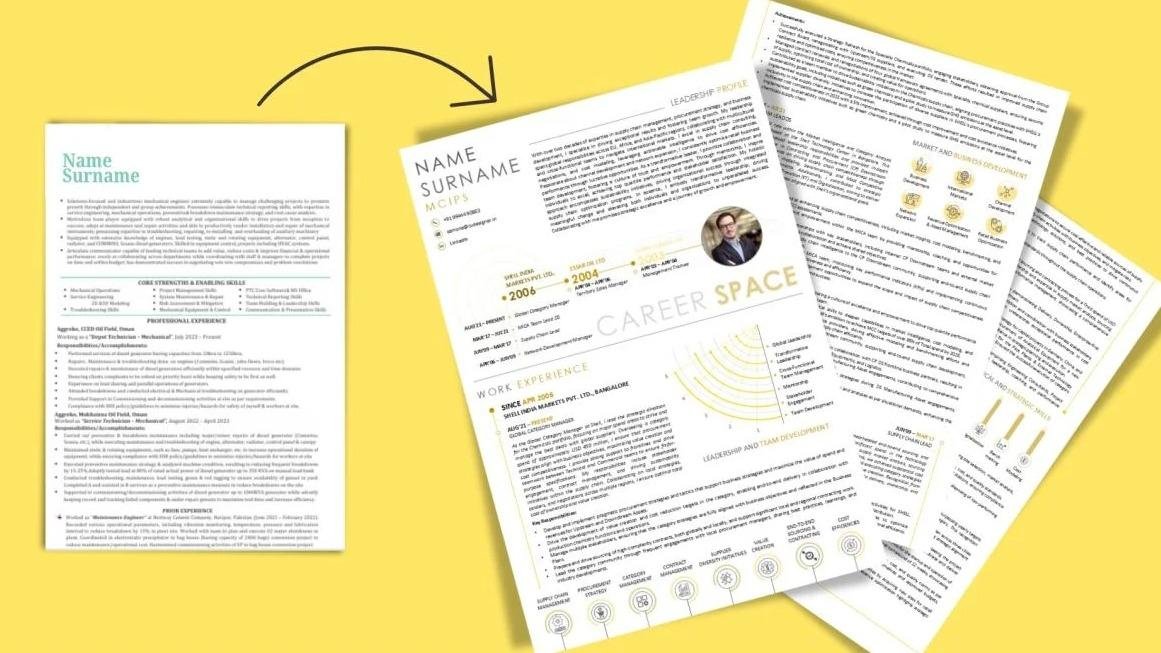
Before & After: How CVDesigner Turned a Senior Leader's Career Into a Document Worth Reading
May 11, 2026. By Samona Sarin
The Uncomfortable Truth About Senior Professional Resumes
Here is something most senior professionals never hear directly: the higher you climb, the worse your resume tends to get.
Not because your experience becomes less impressive. Because your experience becomes so rich, so layered, and so multidimensional that fitting it into a standard document format starts to feel impossible. So you do what most people do. You keep adding bullets. You copy forward from the last version. You write what the role required rather than what you personally delivered. And slowly, over the years, your resume transforms from a career asset into a cluttered archive that recruiters cannot navigate in six seconds - which is precisely how long they try.
This is the situation a senior supply chain and procurement leader came to CVDesigner with. Over two decades at global organisations including Shell India, Essar Oil, and Zuari Cement. A career spanning EU, Africa, and Asia-Pacific operations. Category spends in the hundreds of millions. Sustainability initiatives. Cross-functional leadership. Market intelligence. The kind of profile that should have recruiters reaching out proactively.
Instead, the resume was doing what most executive resumes do: listing responsibilities, burying achievements, and presenting a career that looked busy rather than brilliant.
CVDesigner rebuilt it from scratch. Here is exactly what changed - and why every decision matters.
What the Resume Looked Like Before: A Realistic Picture
We are not sharing the original document out of respect for the client. But after working with hundreds of senior professionals, we can describe what a pre-transformation executive resume at this career level almost always looks like. It probably looked something like this:
A Microsoft Word document, two pages, 11-point Calibri. A header with name and contact details. An "Objective" or "Professional Summary" section that opened with phrases like "results-driven professional with over 20 years of experience" or "dynamic leader with a proven track record." Followed by a chronological list of employers, each with a paragraph of responsibilities and a run of bullet points beginning with "Responsible for," "Managed," "Oversaw," and "Ensured."
Somewhere in the middle - probably buried in the third or fourth bullet of the Shell India section - a reference to overseeing a procurement category spend of USD 450 million. Mentioned in passing. Given the same visual weight as "Ensured compliance with HSE guidelines."
A skills section at the bottom. No visual hierarchy. No career narrative. No sense of the human behind the roles.
This is not a criticism of the person. It is a description of what happens when someone who is exceptional at their job sits down to write about themselves. The instinct is to be thorough, not strategic. To list, not position. To be accurate, not compelling.
And accuracy without strategy is what gets you ignored.
What CVDesigner Built: A Three-Page Executive Career Document
The after version is a three-page executive resume that functions less like a job application and more like a leadership brief. Here is a section-by-section account of what changed and the thinking behind each decision.
The Leadership Profile: From Generic to Commanding
What most resumes do: Open with a summary that describes personality traits - "passionate," "dynamic," "results-driven" - and vague claims of experience duration.
What CVDesigner wrote: A tightly constructed leadership profile that establishes four things in rapid succession: the candidate's primary domain (supply chain management, procurement strategy, and business development), their operational geography (EU, Africa, and Asia-Pacific), their specific capabilities (cost modelling, supply chain consulting, channel development, sustainability initiatives), and the promise of what engaging this professional delivers.
No adjectives. No personality claims. No filler language.
The profile reads like a confident executive briefing because it is written like one. By the time a recruiter finishes the first paragraph, they understand the seniority, the scope, and the specialisation. That is the entire job of an opening profile - and most resumes fail it completely.
The CVDesigner principle at work: Recruiters do not shortlist personalities. They shortlist capabilities. Your summary should tell them what you do, at what scale, and for what outcome - in that order.
The Career Timeline: Turning 22 Years Into a Four-Second Story
What most resumes do: List employers in reverse chronological order with dates tucked to the right margin, making it difficult to visualise career progression at a glance.
What CVDesigner built: A visual career timeline running horizontally across the page, mapping Shell India (2006 to present), Essar Oil (2004 to 2006), and Zuari Cement (2003 to 2004) with colour-coded markers, role titles, and tenure at each employer. The timeline sits prominently in the upper section of the document, before the detailed experience begins.
In 4 seconds, a recruiter can see the entire career arc. They can see the longevity at Shell. They can see the early career progression. They can see a professional who has been consistently employed, consistently advancing, and consistently operating at a serious level.
The CVDesigner principle at work: Humans process visual information faster than text. Converting a reading task into a scanning task is not a design flourish - it is a strategic communication decision. The timeline does in four seconds what two paragraphs of text cannot do in sixty.
The Role Architecture: Separating What the Job Required From What This Person Delivered
What most resumes do: Blend responsibilities and achievements into a single undifferentiated bullet list, making it impossible for a recruiter to know whether a result was the role's mandate or the individual's contribution.
What CVDesigner built: Every role follows a three-part architecture:
- A concise, strategically written role overview (two to three sentences) that contextualises the position within the organisation and establishes the scope of authority.
- A "Key Responsibilities" section with crisp, active bullet points describing the mandate of the role.
- A dedicated "Achievements" section - visually separated and clearly labelled - containing named, specific, quantified outcomes.
This separation is not cosmetic. It is how recruiters think. They want to know what the role required - and then they want to know what this person did inside that role that someone else might not have.
The CVDesigner principle at work: Anyone who held the role "managed procurement." Only this person oversaw a category spend of USD 450 million, achieved a 5% cost competitiveness improvement in 2023, and drove a Strategy Refresh for the Specialty Chemicals portfolio that obtained Group Contract Board approval. The achievement section makes that distinction visible and undeniable.
The Achievements: Specificity as a Credibility Signal
What most resumes do: State achievements vaguely - "improved supply chain efficiency," "reduced costs," "led cross-functional teams" - leaving recruiters with no way to evaluate the scale or the individual's actual contribution.
What CVDesigner surfaced and sharpened:
- A USD 450 million category spend oversight at Shell India, with procurement strategies aligned to global business objectives
- A 5% cost competitiveness improvement in 2023, achieved through targeted cost improvement and avoidance initiatives
- Renegotiation of four global framework agreements with specialty chemical suppliers, securing supply continuity and optimising total cost of ownership
- A Specialty Chemicals Strategy Refresh approved at Group Contract Board level, engaging upstream and downstream stakeholders and re-executing DS tenders
- A Sustainability contribution including green chemistry pilots and GHG emission measurement at asset level - aligned to Shell's Sectoral Decarbonization roadmap
- A cross-regional category strategy for capital projects in Germany, China, and India, managing multiple stakeholders and diverse contracts, achieving a TPSS of 25% of budget
- A VP Special Recognition Award received four times for delivery, ownership, enterprise-first behaviour, and speed
- A supply chain cost reduction of 30% TPSS against approved budget, recognised with special appreciation from EVPs of PTD and CP
These achievements were in the original career. CVDesigner's job was to find them, frame them, and put them where they could not be missed.
The CVDesigner principle at work: Specificity is a credibility signal. "Improved efficiency" is dismissed by recruiters because it is unverifiable. "Achieved a 5% cost competitiveness improvement in 2023 through cost improvement and avoidance initiatives" is believed because it sounds like someone who was close enough to the work to know the numbers.
The Competency Modules: Organising Expertise for Recruiter and ATS
What most resumes do: Drop a bullet list of skills at the bottom of the document - an afterthought that recruiters rarely reach and ATS systems process with variable accuracy.
What CVDesigner built: Themed competency clusters, each visually distinct, grouped by strategic relevance and positioned contextually alongside the roles they relate to:
- Supply Chain Management | Procurement Strategy | Category Management | Contract Management | Supplier Diversity | Value Creation | End-to-End Sourcing | Cost Efficiencies - anchored to the Shell Global Category Manager role
- Business Development | International Markets | Channel Development | Network Expansion | Revenue Optimisation | Retail Business Optimisation - anchored to the MICA Team Lead period
- Sustainability Initiatives | Green Chemistry | Energy Transition | GHG Emission Measurement | Sustainable Procurement | Environmental Compliance - anchored to the sustainability work across Shell
- Supply Chain Consulting | Market Intelligence | Digitalization | Benchmarking | Cost Modelling - anchored to the analytical and strategic period
Radar charts and icon-based visual modules accompany each cluster, making the competency architecture scannable at a glance.
The CVDesigner principle at work: Keyword alignment is not just an ATS requirement. When a recruiter sees their exact domain language reflected back in a resume, it triggers immediate recognition and relevance. Organising competencies thematically and contextually signals mastery, not just familiarity.
The Visual Design: Premium Without Being Decorative
What most resumes do: Use a default template that looks identical to ten thousand other resumes in the same inbox.
What CVDesigner designed: A two-column layout with a warm gold and charcoal palette. Clear typographic hierarchy distinguishing company names, role titles, dates, body text, and callouts. A career timeline as a navigational anchor. Radar charts for leadership and competency dimensions. Icon-based skill modules that create visual rhythm without sacrificing substance. Section dividers that guide the eye without cluttering the page.
The design is premium, not decorative. Every visual element serves an information architecture purpose. Nothing exists simply to look interesting.
The CVDesigner principle at work: At the executive level, how you present yourself is part of your brand. A resume that looks like it was formatted in an afternoon signals a different level of professional self-awareness than one that has been intentionally designed. Recruiters and hiring managers notice this - even when they cannot articulate why one resume felt more credible than another.
The Recruiter Psychology Behind Every Decision
Every choice CVDesigner makes in a resume transformation is grounded in how senior recruiters and executive search professionals actually process documents.
The six-second rule is real. Initial resume screening is a triage activity, not an evaluation. The goal of the first pass is elimination, not selection. A resume that does not surface seniority, relevance, and credibility in six seconds does not get a second pass.
Visual hierarchy creates trust before content does. A well-structured document is unconsciously perceived as the work of a well-structured thinker. The inverse is also true.
Passive language signals subordination. "Was responsible for" and "assisted with" tell a recruiter that this person was part of something. "Led," "delivered," "negotiated," and "achieved" tell them this person owned something. For senior roles, ownership language is non-negotiable.
Specificity is shorthand for credibility. The more specific an achievement, the more believable it is. Vague claims are mentally discounted. Precise claims - with numbers, contexts, and outcomes - are unconsciously accepted as true.
The first ten lines determine whether the rest gets read. If the leadership profile and most recent role do not immediately establish relevance and seniority, most recruiters will not read further. The top of the document carries disproportionate weight, which is why CVDesigner treats it as the most strategically important real estate on the page.
How to Know If Your Resume Needs This Kind of Transformation
Ask yourself honestly:
- Have you applied to ten or more relevant roles in the past three months with fewer than two screening calls?
- Does your resume describe what your roles required rather than what you personally delivered?
- Is your most significant career achievement buried somewhere in the middle of a bullet list?
- Does your resume look substantially similar to the one you had five years ago?
- Could a recruiter reading your resume for six seconds identify your seniority level and domain expertise without reading a single bullet point?
Two or more yes answers means the document is working against you. Not your experience. The document.
Common Mistakes Senior Leaders Make on Their Resumes
- Leading with a personality description instead of a strategic positioning statement
- Giving responsibilities and achievements equal visual weight, making it impossible to identify impact
- Failing to quantify outcomes - team sizes, budget ownership, percentage improvements, revenue figures
- Using the same resume for every role without tailoring keyword alignment
- Treating LinkedIn as a secondary document rather than a parallel brand asset
- Presenting a career timeline that requires reading to understand rather than scanning
- Neglecting to address the leadership philosophy and culture-fit signals that matter at senior level
Best Practices for Executive Resume Writing in 2025
- Open with a positioning statement, not a personality description
- Build every role around a three-part structure: overview, responsibilities, and achievements
- Quantify everything that can be quantified - and surface the biggest numbers prominently
- Use visual hierarchy so that the six-second scan reveals your most important information first
- Group competencies thematically and position them contextually alongside relevant roles
- Align language precisely to the roles and industries you are targeting
- Ensure your resume, LinkedIn profile, and career narrative tell a consistent, complementary story
Is a Professional Resume Writing Service Worth It for Senior Leaders?
The return on investment conversation for executive resume writing is straightforward. A professionally built resume that helps you secure one additional interview - and convert it into an offer at the compensation level your experience warrants - pays for the service many times over. For senior professionals where packages are meaningful, the cost of a three-month job search extension while an underperforming resume circulates is far greater than the cost of doing this properly from the start.
The more honest question is not whether it is worth it. It is what the current version of your resume has already cost you.
Work With CVDesigner
CVDesigner builds executive-grade resumes, LinkedIn profiles, and career narratives for senior professionals who know their experience deserves better representation than a Word document with updated dates can provide.
Every engagement begins with your career story, your target, and the specific impression you need to make at the level you are pursuing. What follows is a strategically written, professionally designed career document - not a template, not a fill-in-the-blanks exercise, but a bespoke positioning asset built for the opportunities you are actually going after.
Visit cvdesigner.in to explore executive resume writing, LinkedIn optimisation, ATS strategy, and career branding services.
Frequently Asked Questions
Q1. What exactly does a professional resume writing service do differently?
A professional resume writing service does not just reformat what you have. It conducts a strategic audit of your career, identifies the achievements that carry the most weight for your target roles, restructures your content architecture for recruiter readability, optimises for ATS keyword alignment, and applies professional design that communicates seniority before a word is read. The result is a document that positions you - not just lists you.
Q2. Why is my resume not getting shortlisted despite strong experience?
The most common reasons are ATS keyword mismatches, achievement-free bullet points, a summary that fails to differentiate you from other applicants at your level, and visual formatting that does not survive the initial six-second scan. Strong experience and a strong resume are different things. CVDesigner bridges the gap between the two.
Q3. How long should an executive resume be in 2025?
For senior leaders with fifteen or more years of experience, two to three pages is appropriate and expected. The priority is not length - it is information density, visual clarity, and strategic sequencing. A three-page document with clear hierarchy reads more efficiently than a two-page wall of undifferentiated text.
Q4. Should an executive resume include a photograph?
This depends on geography and industry norms. In India and much of the Middle East, a professional photograph is standard. In the US and UK, photographs are typically excluded to reduce the potential for unconscious bias in early screening. CVDesigner advises based on your specific target market and the types of organisations you are approaching.
Q5. How is CVDesigner different from other resume writing services?
CVDesigner focuses on executive career branding rather than templated document production. Every resume is built around a deep understanding of your career story, target positioning, and the specific expectations of senior recruiters in your domain. The output is a bespoke career document - not a form letter with your name at the top.
CVDesigner transforms executive resumes by rebuilding career narratives from the ground up - replacing duty-based bullet points with quantified achievements, applying ATS-optimised keyword architecture, and using professional visual design that communicates leadership authority within seconds. The result is a document that positions a senior professional precisely for the roles they are targeting.
Your career deserves a document that matches it.
If you are a senior leader whose resume reads like a job description rather than a leadership story, CVDesigner can change that. Executive resume writing, LinkedIn optimisation, ATS strategy, and career branding - built around your specific story and the roles you are actually targeting.
RECENT BLOGS
-

How to Write a Senior Customer Success CV That Actually Gets You Noticed
-

Why the Best Procurement Leaders Are the Hardest to Hire
-

The Single-Employer Trap: Why 20 Years at One Company Can Look Like Standing Still - and How CVDesigner Fixed It
-

The Patent Paradox: Why the Most Credentialed Aerospace Executives Have the Weakest Resumes
ADD COMMENTS
Your email address will not be published. Required fields are marked *